Annotations
Annotations are key-value pairs that can be attached to various entities for custom metadata and policy decisions. They support inheritance hierarchies that allow general definitions to be overridden by more specific ones.
Overview
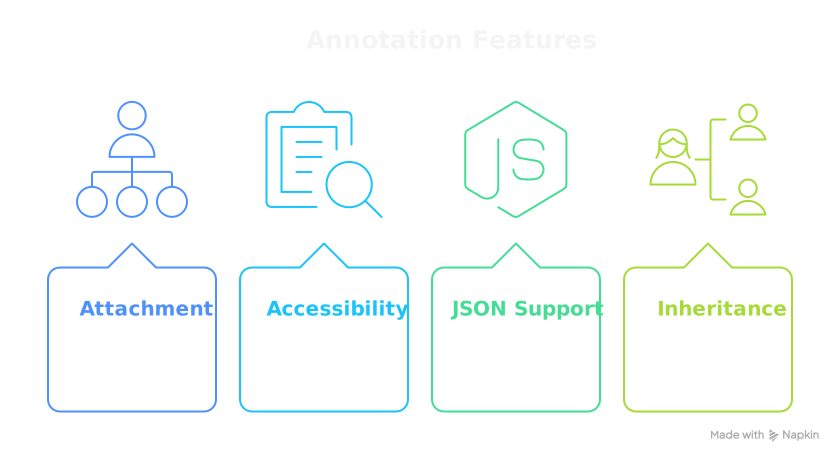
Annotations provide flexible metadata that:
- Can be attached to roles, groups, scopes, resource groups, resources, and principals
- Are accessible during policy evaluation via the PORC
- Support any valid JSON values
- Follow inheritance hierarchies where more specific definitions take precedence
Parameterizing Policies
Annotations enable a powerful pattern: generic policies that are parameterized by entity configuration.
Consider this policy that checks if a principal's environment matches the resource's environment:
package authz

default allow = false

allow {
    input.principal.mannotations.environment == input.resource.annotations.environment
}
This policy is completely generic—it doesn't mention any specific environment. The role and resource group definitions parameterize it:
roles:
  - mrn: "mrn:iam:role:finance-analyst"
    name: finance-analyst
    policy: "mrn:iam:policy:environment-match"
    annotations:
      - name: environment
        value: finance            # This role grants access to "finance" resources

resource-groups:
  - mrn: "mrn:iam:resource-group:finance-data"
    name: finance-data
    policy: "mrn:iam:policy:resource-access"
    annotations:
      - name: environment
        value: finance            # Resources in this group are tagged "finance"
When a principal with the finance-analyst role accesses a resource in the finance-data group:
- The role's
environment: "finance"annotation flows intoinput.principal.mannotations - The resource group's
environment: "finance"annotation flows intoinput.resource.annotations - The generic policy evaluates the match and grants access
This pattern is fundamental to the PolicyEngine architecture. Entities like Roles, Groups, Scopes, and Resource Groups serve a dual purpose:
- Policy selection: They link to a policy that contains the access control logic
- Policy parameterization: They provide annotations that flow into the PORC, giving the policy context-specific values to evaluate
This separation means you can:
- Write generic, reusable policies that work across many contexts
- Configure access through entity definitions without modifying policy code
- Create new access patterns by defining new roles or resource groups with different annotations
Where Annotations Apply
Annotations can be defined on multiple entity types:
| Entity | Defined In | Description |
|---|---|---|
| Role | PolicyDomain spec.roles[].annotations | Role-specific metadata |
| Group | PolicyDomain spec.groups[].annotations | Group-specific metadata |
| Scope | PolicyDomain spec.scopes[].annotations | Scope-specific metadata |
| Resource Group | PolicyDomain spec.resource-groups[].annotations | Resource group metadata |
| Resource | PolicyDomain spec.resources[].annotations, or external resource resolution Premium Only | Resource-specific metadata |
| Principal | JWT claims | Identity-level metadata |
Annotation Inheritance
Annotations follow inheritance hierarchies where conflicts are resolved by precedence rules. More specific or contextual definitions override more general ones.
Identity Annotation Hierarchy
For identity-related annotations (available in input.principal.mannotations), the inheritance order from least to most dominant is:
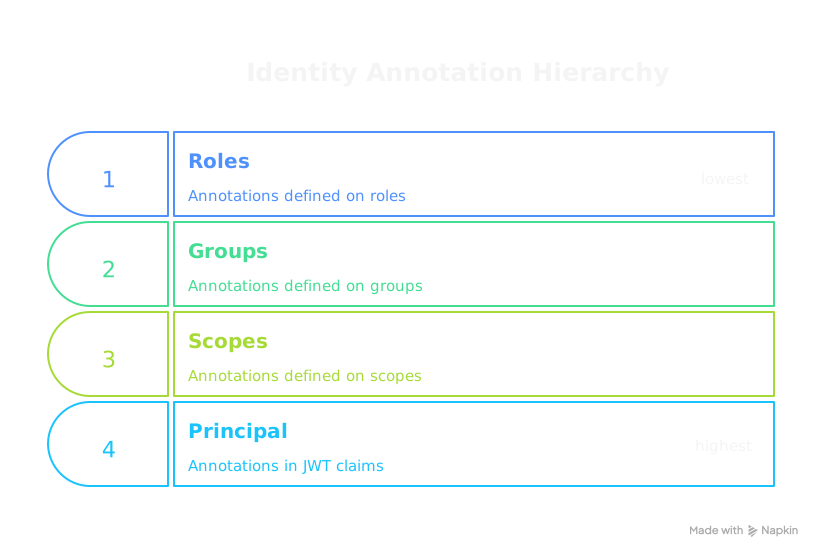
Example: If the same annotation key department is defined on both a Role and a Group that apply to a request, the Group's value takes precedence. If also defined in the principal's JWT claims, that value wins.
# Role definition
roles:
  - mrn: "mrn:iam:role:developer"
    annotations:
      - name: department
        value: engineering         # Precedence 1
      - name: access_level
        value: standard

# Group definition
groups:
  - mrn: "mrn:iam:group:platform-team"
    annotations:
      - name: department
        value: platform            # Precedence 2 - overrides role
      - name: team
        value: infrastructure

# Scope definition (if applicable)
scopes:
  - mrn: "mrn:iam:scope:elevated"
    annotations:
      - name: access_level
        value: elevated            # Precedence 3 - overrides role

# Principal JWT claims
principal:
  mannotations:
    department: "security"         # Precedence 4 - overrides all others
Resulting input.principal.mannotations:
{
  "department": "security",      // From principal (highest precedence)
  "access_level": "elevated",    // From scope
  "team": "infrastructure"       // From group (no conflict)
}
Resource Annotation Hierarchy
For resource-related annotations (available in input.resource.annotations), the inheritance order from least to most dominant is:
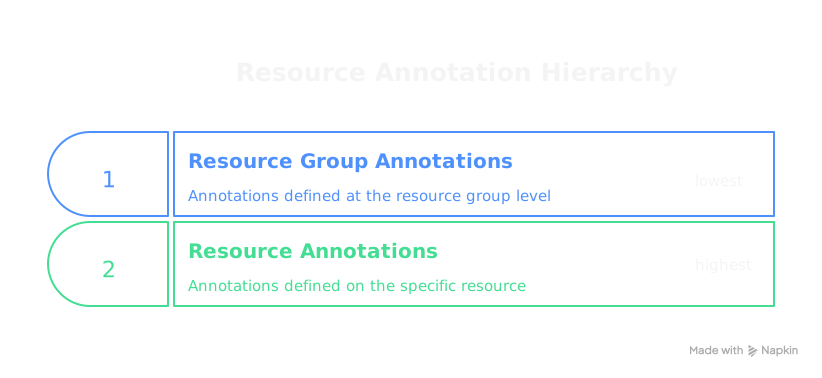
Example: If a resource belongs to a resource group, annotations from the resource group are inherited, but any annotations defined directly on the resource take precedence.
# Resource Group definition
resource-groups:
  - mrn: "mrn:iam:resource-group:customer-data"
    annotations:
      - name: data_classification
        value: confidential
      - name: retention_days
        value: 365
      - name: requires_audit
        value: true

# Resource with override
resource:
  id: "mrn:data:customer:12345"
  annotations:
    - name: retention_days
      value: 730                   # Overrides resource group
    - name: special_handling
      value: true                  # Additional annotation
Resulting input.resource.annotations:
{
  "data_classification": "confidential",  // From resource group
  "retention_days": "730",                // From resource (overrides)
  "requires_audit": "true",               // From resource group
  "special_handling": "true"              // From resource (new)
}
Merge Strategies
Merge strategies are available in PolicyDomain schema version v1alpha4 and later (including v1beta1).
When annotation keys conflict across inheritance levels, merge strategies determine how values are combined. The default strategy is deep, which recursively merges arrays and objects while letting higher-priority scalar values win. You can specify different strategies to control this behavior precisely.
Merge strategies are particularly useful for:
- Accumulating permissions: Combining tags, capabilities, or allowed regions from multiple sources
- Building configurations: Merging objects where each level adds or overrides specific fields
- Set operations: Creating deduplicated lists from multiple sources
Available Strategies
| Strategy | Arrays | Objects | Scalars |
|---|---|---|---|
replace | Higher replaces lower | Higher replaces lower | Higher wins |
append | [higher..., lower...] | Shallow merge, higher wins | Higher wins |
prepend | [lower..., higher...] | Shallow merge, lower wins | Lower wins |
deep | [higher..., lower...] | Recursive merge, higher wins | Higher wins |
union | Deduplicated set, higher first | Same as deep | Higher wins |
The default strategy is deep when no strategy is specified.
Specifying a Merge Strategy
Add the merge field to an annotation to control how it combines with values from lower-priority sources:
roles:
  - mrn: "mrn:iam:role:developer"
    annotations:
      - name: allowed_regions
        value:
          - us-west
        merge: union             # Deduplicate when combined with other sources

groups:
  - mrn: "mrn:iam:group:global-team"
    annotations:
      - name: allowed_regions
        value:
          - us-east
          - eu-west
        merge: union             # Combined result: ["us-east", "eu-west", "us-west"]
Strategy Precedence
When merging annotations, the strategy is determined by priority:
- Higher-priority source's strategy (if specified)
- Lower-priority source's strategy (if higher has none)
- Default strategy (
deep)
Merge Strategy Examples
Accumulating Tags with Union
Use union to collect unique values from all sources:
roles:
  - mrn: "mrn:iam:role:developer"
    annotations:
      - name: tags
        value:
          - dev
          - internal
        merge: union

groups:
  - mrn: "mrn:iam:group:platform-team"
    annotations:
      - name: tags
        value:
          - platform
          - internal
        merge: union
Result: ["platform", "internal", "dev"] (deduplicated, higher priority first)
Building Configuration Objects with Deep Merge
Use deep to recursively merge nested objects:
roles:
  - mrn: "mrn:iam:role:developer"
    annotations:
      - name: config
        value:
          timeouts:
            read: 30
            write: 60
          retries: 3
        merge: deep

groups:
  - mrn: "mrn:iam:group:premium-users"
    annotations:
      - name: config
        value:
          timeouts:
            write: 120
          priority: high
        merge: deep
Result:
{
  "timeouts": {"read": 30, "write": 120},
  "retries": 3,
  "priority": "high"
}
Preserving Order with Append/Prepend
Use append to add lower-priority elements after higher-priority ones:
resource-groups:
  - mrn: "mrn:iam:resource-group:base"
    annotations:
      - name: processing_steps
        value:
          - validate
          - log
        merge: append

resources:
  - selector: ["mrn:data:sensitive:.*"]
    group: "mrn:iam:resource-group:base"
    annotations:
      - name: processing_steps
        value:
          - encrypt
          - audit
        merge: append
Result: ["encrypt", "audit", "validate", "log"] (higher priority first)
Use prepend to add lower-priority elements before higher-priority ones:
# Same as above but with prepend
annotations:
  - name: processing_steps
    value:
      - encrypt
      - audit
    merge: prepend
Result: ["validate", "log", "encrypt", "audit"] (lower priority first)
Replacing Values Explicitly
Use replace when you want to completely override a lower-priority value:
roles:
  - mrn: "mrn:iam:role:standard-user"
    annotations:
      - name: permissions
        value:
          - read
          - list

groups:
  - mrn: "mrn:iam:group:admin"
    annotations:
      - name: permissions
        value:
          - read
          - write
          - delete
          - admin
        merge: replace            # Completely replaces role permissions
Result: ["read", "write", "delete", "admin"] (role permissions ignored)
Type Mismatch Behavior
When conflicting values have incompatible types (e.g., array vs. string), the higher-priority value always wins regardless of the merge strategy:
roles:
  - mrn: "mrn:iam:role:basic"
    annotations:
      - name: access
        value:
          - read                  # Array

groups:
  - mrn: "mrn:iam:group:special"
    annotations:
      - name: access
        value: full               # String (incompatible type)
        merge: union              # Strategy is ignored for type mismatch
Result: "full" (higher priority wins due to type mismatch)
Inheritance Use Cases
Establishing Defaults with Overrides
Define baseline annotations at a general level and override for specific cases:
# All developers get standard access
roles:
  - mrn: "mrn:iam:role:developer"
    annotations:
      - name: max_data_size
        value: 1GB
      - name: can_export
        value: false

# Platform team members can export
groups:
  - mrn: "mrn:iam:group:platform-team"
    annotations:
      - name: can_export
        value: true                # Override for this group
Layered Security Classifications
Apply cumulative security requirements:
resource-groups:
  - mrn: "mrn:iam:resource-group:pii"
    annotations:
      - name: classification
        value: PII
      - name: encryption_required
        value: true

# Specific high-value resource
resource:
  annotations:
    - name: classification
      value: PII-HIGH              # More specific classification
    - name: two_person_rule
      value: true                  # Additional requirement
Annotation Structure
Annotations are defined as a list of objects with the following fields:
| Field | Required | Description |
|---|---|---|
name | Yes | The annotation key (string) |
value | Yes | The annotation value (native YAML in v1beta1, JSON-encoded string in v1alpha3/4) |
merge | No | Merge strategy: replace, append, prepend, deep, or union |
v1beta1: Native YAML Values (Recommended)
In v1beta1, annotation values are written as native YAML—no JSON encoding required:
annotations:
  - name: department
    value: engineering              # String
  - name: cost_center
    value: 12345                    # Number
  - name: tags
    value:                          # Array
      - production
      - critical
  - name: metadata
    value:                          # Object
      created_by: admin
      version: 2
  - name: enabled
    value: true                     # Boolean
This is cleaner to read and write than the legacy JSON-encoded format.
Legacy Format (v1alpha3/v1alpha4)
In older schema versions, values must be JSON-encoded strings:
String values require nested quotes. The outer quotes are YAML string delimiters; the inner escaped quotes are the JSON string value.
| Type | v1alpha4 (JSON-encoded) | v1beta1 (Native) |
|---|---|---|
| String | "\"engineering\"" | engineering |
| Number | "12345" | 12345 |
| Boolean | "true" | true |
| Array | '["read", "write"]' | - read- write |
| Object | '{"region": "us-west"}' | region: us-west |
# v1alpha4 - JSON-encoded (required)
annotations:
  - name: "department"
    value: "\"engineering\""    # Parsed as JSON string: "engineering"

# v1beta1 - Native YAML (recommended)
annotations:
  - name: department
    value: engineering          # Much cleaner!
After parsing, annotations are available in policies as native values regardless of schema version:
{
  "department": "engineering",
  "cost_center": 12345,
  "tags": ["production", "critical"],
  "metadata": {
    "created_by": "admin",
    "version": 2
  },
  "enabled": true
}
Using Annotations in Policies
Simple Value Checks
package authz

default allow = false

# Check department
allow {
    input.principal.mannotations.department == "engineering"
}

# Check resource tag
allow {
    input.resource.annotations.environment == "production"
}
Array Annotations
package authz

default allow = false

# Principal must have required capability
allow {
    "admin" in input.principal.mannotations.capabilities
}

# Resource must have a matching tag
allow {
    some tag in input.resource.annotations.tags
    tag in input.principal.mannotations.allowed_tags
}
Nested Annotations
package authz

default allow = false

# Check nested value
allow {
    input.resource.annotations.metadata.level >= 2
}
Matching Annotations
package authz

default allow = false

# Principal and resource department must match
allow {
    input.principal.mannotations.department == input.resource.annotations.department
}

# Principal must have access to the resource's region
allow {
    input.resource.annotations.region in input.principal.mannotations.allowed_regions
}
Defining Annotations in PolicyDomain
On Roles
spec:
  roles:
    - mrn: "mrn:iam:role:regional-admin"
      name: regional-admin
      annotations:
        - name: region
          value: us-west
        - name: permissions
          value:
            - read
            - write
            - admin
      policy: "mrn:iam:policy:regional-access"
On Groups
spec:
  groups:
    - mrn: "mrn:iam:group:finance"
      name: finance
      annotations:
        - name: department
          value: finance
        - name: cost_center
          value: 12345
      roles:
        - "mrn:iam:role:finance-user"
On Resource Groups
spec:
  resource-groups:
    - mrn: "mrn:iam:resource-group:pii-data"
      name: pii-data
      annotations:
        - name: data_classification
          value: PII
        - name: retention_days
          value: 365
        - name: requires_audit
          value: true
      policy: "mrn:iam:policy:pii-access"
Common Annotation Patterns
Department/Team Access
package authz

default allow = false

# Same department access
allow {
    input.principal.mannotations.department == input.resource.annotations.department
}
Geographic Restrictions
package authz

default allow = false

# Principal's region must include the resource's region
allow {
    input.resource.annotations.region in input.principal.mannotations.allowed_regions
}
Time-Based Annotations
package authz

default allow = false

# Check if access hasn't expired
allow {
    expires := time.parse_rfc3339_ns(input.resource.annotations.access_expires)
    expires > time.now_ns()
}
Feature Flags
package authz

default allow = false

# Check feature flag
allow {
    input.principal.mannotations.beta_features == true
    startswith(input.operation, "beta:")
}
Best Practices
- Use consistent keys: Establish naming conventions across all entity types
- Keep values simple: Prefer primitives over complex objects
- Don't store sensitive data: Annotations are not encrypted
- Document annotations: Maintain a reference of used annotations and their expected sources
- Validate at ingestion: Ensure annotation values are valid before storage
- Design for inheritance: Place default values at lower precedence levels (roles, resource groups) and overrides at higher levels
- Be explicit about precedence: When the same key appears at multiple levels, document the intended override behavior
- Avoid deep nesting: While nested objects are supported, flatter structures are easier to reason about in policies
- Choose merge strategies intentionally: Use
unionfor accumulating unique values,deepfor configuration objects, andreplacewhen you need complete override behavior - Be consistent with strategies: If an annotation key uses a specific merge strategy, use the same strategy at all inheritance levels to avoid confusion