Examples
This section contains complete, production-ready examples demonstrating the power and flexibility of the Manetu PolicyEngine. Each example includes:
- A complete PolicyDomain definition with all necessary policies, roles, groups, and resource groups
-
Test cases that you can run with
mpe test decisionto verify behavior - Detailed explanations of the design decisions and patterns used
Featured Examples
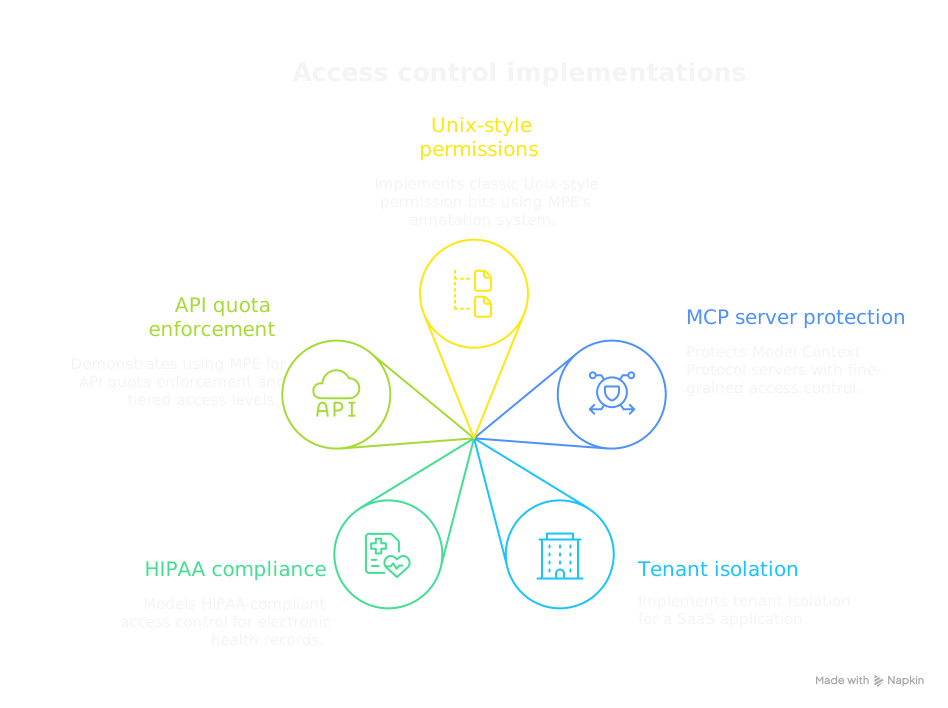
Unix Filesystem Permissions
Implements classic Unix-style permission bits (read/write for owner/group/other) using MPE's annotation system. Demonstrates how to:
- Use resource annotations to store permission bits
- Compare principal identity against resource ownership
- Check group membership for group-level permissions
- Fall back to "other" permissions for unrelated principals
MCP Server Access Control
Protects Model Context Protocol (MCP) servers with fine-grained access control for both metadata operations (tool:list, prompt:list) and data-path operations (tool:call, resource:read). Demonstrates:
- Operation-based routing for different API endpoints
- Tool-level permissions using annotations
- Server registration and discovery controls
Multi-Tenant SaaS
Implements tenant isolation for a SaaS application where users belong to organizations and can only access resources within their tenant. Features:
- Strict tenant boundary enforcement
- Cross-tenant admin access for support teams
- Organization-based group membership
- Tenant-scoped resource groups
Healthcare Data Access (HIPAA)
Models HIPAA-compliant access control for electronic health records (EHR) with role-based access, patient consent, and break-glass emergency procedures. Includes:
- Role hierarchy (physician, nurse, admin, patient)
- Patient consent checking via resource annotations
- Break-glass emergency access with audit flags
- Minimum necessary access principle
API Quotas and Rate Limiting
Demonstrates using MPE for API quota enforcement and tiered access levels. Shows how to:
- Define subscription tiers with different limits
- Use annotations to track quota metadata
- Implement feature flags per subscription level
- Distinguish between billing tiers at policy evaluation time
Running the Examples
Each example includes a complete PolicyDomain YAML file and test input. Download links are available on each example page.
1. Validate the PolicyDomain
mpe lint -f policydomain.yml
2. Test Policy Decisions
# Test a specific scenario
mpe test decision -b policydomain.yml -i input.json

# Check just the decision
mpe test decision -b policydomain.yml -i input.json | jq .decision
3. Explore the Full Access Record
# See all policy references and phase evaluations
mpe test decision -b policydomain.yml -i input.json | jq .
Building Your Own
These examples are designed to be starting points. Feel free to:
- Copy and modify any example to fit your use case
- Combine patterns from multiple examples
- Extract reusable logic into Policy Libraries
Best Practices Demonstrated
These examples showcase several recommended patterns:
-
Default deny for tri-level policies: Using
default allow = -1with positive grants instead of explicit denies -
Utils library pattern: Extracting common helpers like
has_principalinto a sharedutilslibrary -
Set iteration: Using
some x in {...}for concise, maintainable Rego -
Operation prefixes: Using prefixes like
mcp:to enable meaningful identity phase checks - Multiple libraries: Combining general utilities with domain-specific helpers
For more details on these patterns, see Writing Concise Rego and The Utils Library Pattern.
For more information on building PolicyDomains, see: