PolicyDomains
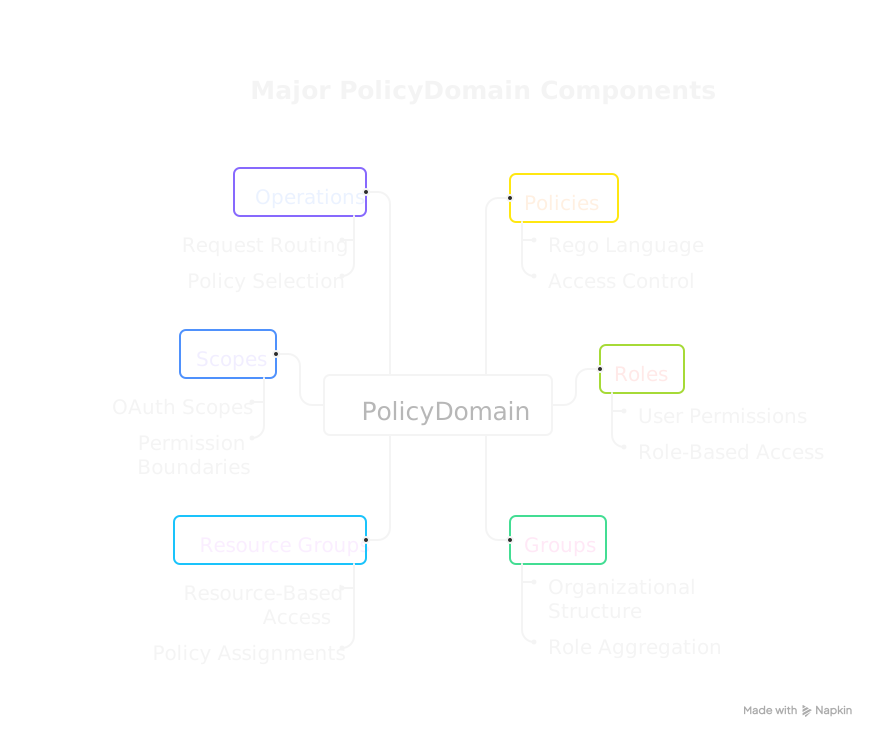
A PolicyDomain is a self-contained bundle that defines all policy-related artifacts for a specific domain or service.
Overview
PolicyDomains provide:
- Modularity: Package related policies together
- Portability: Deploy policies as a single unit
- Reusability: Share libraries across policies within a domain
- Versioning: Track changes to policy bundles
PolicyDomain Structure
apiVersion: iamlite.manetu.io/v1beta1
kind: PolicyDomain
metadata:
  name: my-domain
spec:
  policy-libraries: []   # Reusable Rego code
  policies: []           # Access control policies
  roles: []              # Role-to-policy mappings
  groups: []             # Group-to-role mappings
  resource-groups: []    # Resource-to-policy mappings
  resources: []          # Resource selector routing
  scopes: []             # Access-method constraint policies
  operations: []         # Operation routing
  mappers: []            # Input transformation
API Version and Kind
Every PolicyDomain document must specify an API version and kind:
apiVersion: iamlite.manetu.io/v1beta1
kind: PolicyDomain  # or PolicyDomainReference
Supported API versions: v1alpha3, v1alpha4, v1beta1
v1beta1 supports native YAML annotation values, eliminating the need for JSON-encoded strings. This makes PolicyDomains easier to read and write.
Supported kinds:
| Kind | Description |
|---|---|
PolicyDomain | Deployment format with inline Rego code |
PolicyDomainReference | Development format that can reference external .rego files |
See PolicyDomain vs PolicyDomainReference for detailed guidance on when to use each format.
Metadata
metadata:
  name: my-service-policies
The name uniquely identifies the domain. It's used for:
- Cross-domain references
- Logging and debugging
- Bundle identification
Components Overview
Policy Libraries
Reusable Rego code shared across policies:
spec:
  policy-libraries:
    - mrn: "mrn:iam:library:helpers"
      name: helpers
      rego: |
        package helpers
        # Shared functions...
Policies
The Rego code that makes access decisions:
spec:
  policies:
    - mrn: "mrn:iam:policy:main"
      name: main
      dependencies:
        - "mrn:iam:library:helpers"
      rego: |
        package authz
        # Policy logic...
Roles, Groups, Resource Groups, Resources, Scopes
Identity and resource mappings:
spec:
  roles:
    - mrn: "mrn:iam:role:admin"
      name: admin
      policy: "mrn:iam:policy:allow-all"

  groups:
    - mrn: "mrn:iam:group:admins"
      name: admins
      roles:
        - "mrn:iam:role:admin"

  resource-groups:
    - mrn: "mrn:iam:resource-group:default"
      name: default
      default: true
      policy: "mrn:iam:policy:allow-all"

  # v1alpha4+: Route resources to groups by MRN pattern
  resources:
    - name: sensitive-data
      selector:
        - "mrn:data:sensitive:.*"
      group: "mrn:iam:resource-group:restricted"

  scopes:
    - mrn: "mrn:iam:scope:api"
      name: api
      policy: "mrn:iam:policy:allow-all"
Operations and Mappers
Request routing and transformation:
spec:
  operations:
    - name: api
      selector: [".*"]
      policy: "mrn:iam:policy:main"

  mappers:
    - name: http-mapper
      selector: [".*"]
      rego: |
        package mapper
        # Transform input to PORC...
Using YAML Anchors
YAML anchors increase PolicyDomain maintainability:
spec:
  policies:
    - mrn: &allow-all "mrn:iam:policy:allow-all"
      name: allow-all
      rego: |
        package authz
        default allow = true

  roles:
    - mrn: "mrn:iam:role:admin"
      name: admin
      policy: *allow-all  # Reference the anchor
PolicyDomain vs PolicyDomainReference
The PolicyEngine supports two document formats that serve different purposes in the development and deployment workflow.
Key Differences
| Aspect | PolicyDomain | PolicyDomainReference |
|---|---|---|
| Rego code | Inline rego field only | Either rego (inline) or rego_filename (external file) |
| Primary use | Deployment, runtime evaluation | Development, source control |
| Kubernetes Operator | Supported (Premium) | Must convert with mpe build first |
| Community tooling | Fully supported | Fully supported |
PolicyDomainReference Format
PolicyDomainReference is a superset of PolicyDomain that allows referencing external .rego files instead of embedding Rego code inline. This is the recommended format for development because:
- IDE support: Separate
.regofiles get proper syntax highlighting - Easier testing: Test individual Rego files with standard OPA tooling
- Cleaner diffs: Policy logic changes are isolated from YAML structure
- Better organization: Keep complex policies in dedicated files
apiVersion: iamlite.manetu.io/v1beta1
kind: PolicyDomainReference
metadata:
  name: my-domain
spec:
  policy-libraries:
    - mrn: "mrn:iam:library:helpers"
      name: helpers
      rego_filename: lib/helpers.rego    # External file

  policies:
    - mrn: "mrn:iam:policy:main"
      name: main
      dependencies:
        - "mrn:iam:library:helpers"
      rego_filename: policies/main.rego  # External file

    - mrn: "mrn:iam:policy:simple"
      name: simple
      rego: |                            # Inline is also allowed
        package authz
        default allow = true
The rego_filename field is supported on:
policiespolicy-librariesmappers
Converting to PolicyDomain
Use mpe build to convert PolicyDomainReference to PolicyDomain:
# Convert for deployment
mpe build -f my-domain-ref.yaml -o my-domain.yaml
The build process:
- Reads each
rego_filenamereference - Loads the external
.regofile content - Replaces
rego_filenamewith inlinerego - Changes
kindfromPolicyDomainReferencetoPolicyDomain
Which Format Should I Use?
Community Users: All tooling (mpe test, mpe serve, Go API) accepts both formats interchangeably. Choose based on your preference:
- Use
PolicyDomainReferenceif you prefer separate.regofiles - Use
PolicyDomainif you prefer everything in one file
Premium Users: The Kubernetes Operator only accepts PolicyDomain format. You can:
- Develop using
PolicyDomainReferencefor better IDE support - Run
mpe buildas part of your CI/CD pipeline before deployment - Or develop directly in
PolicyDomainformat if you prefer
Development Workflow Example
my-policies/
├── domain.yaml              # PolicyDomainReference
├── lib/
│   └── helpers.rego         # Shared library code
├── policies/
│   ├── identity.rego        # Identity phase policy
│   └── resource.rego        # Resource phase policy
└── build/
    └── domain-built.yaml    # Generated PolicyDomain (git-ignored)
Build command in CI/CD:
mpe build -f domain.yaml -o build/domain-built.yaml
Multiple Domains
You can load multiple PolicyDomains together:
mpe test decision \
  -b base-policies.yml \
  -b service-policies.yml \
  -i input.json
Cross-domain library references use the format:
dependencies:
  - "other-domain/library-name"
GitOps-Friendly Design
PolicyDomains are fundamentally GitOps-friendly because they are plain files—YAML documents that can be version-controlled, reviewed, tested, and deployed through any standard GitOps workflow.
Why Plain Files Matter
- Human-readable: Easy to review in pull requests
- Diff-friendly: Changes are clearly visible in version control
- Declarative: Describes the desired state, not imperative steps
- Tooling support: Standard YAML linting, formatting, and validation
- Portable: Deploy through any file-based workflow
Deployment Patterns
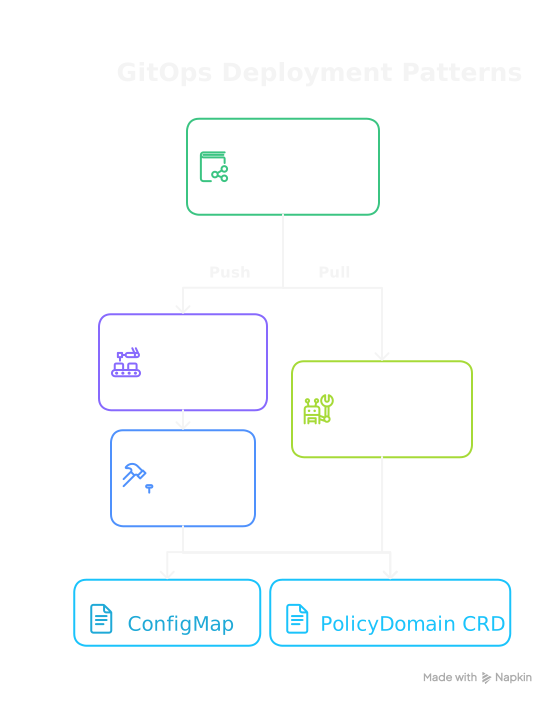
Because PolicyDomains are just files, they integrate with any GitOps-oriented deployment flow:
| Pattern | Description |
|---|---|
| Push-based | Git → CI pipeline → kubectl apply to Kubernetes |
| Pull-based | GitOps operators (Flux, ArgoCD) continuously sync from Git |
Delivery by Edition
ConfigMap-based delivery
In the Community Edition, PolicyDomains are typically delivered as Kubernetes ConfigMaps. Configure your PDP pods (for HTTP API integration) or application pods (for embedded Go) to trigger a rolling restart when the ConfigMap changes:
apiVersion: v1
kind: ConfigMap
metadata:
  name: policy-domain
data:
  domain.yaml: |
    apiVersion: iamlite.manetu.io/v1beta1
    kind: PolicyDomain
    metadata:
      name: my-service
    spec:
      # ... PolicyDomain content
---
apiVersion: apps/v1
kind: Deployment
metadata:
  name: mpe-pdp
spec:
  template:
    metadata:
      annotations:
        # Trigger rollout when ConfigMap changes
        checksum/config: "{{ sha256sum .Values.policyDomain }}"
CRD-based delivery with dynamic updates
The Premium Edition provides a Kubernetes Custom Resource Definition (CRD) for PolicyDomain resources. When a PolicyDomain CRD instance is created or updated—whether through CI push or a GitOps operator pull—the Policy Administration Point (PAP) automatically distributes the new policies to all PDPs through the cache-coherency mechanism. No pod restarts required.
apiVersion: iamlite.manetu.io/v1beta1
kind: PolicyDomain
metadata:
  name: my-service
spec:
  # ... PolicyDomain content
Example CI Pipeline
# .github/workflows/policy-ci.yml
name: Policy CI

on:
  push:
    paths:
      - 'policies/**'
  pull_request:
    paths:
      - 'policies/**'

jobs:
  validate:
    runs-on: ubuntu-latest
    steps:
      - uses: actions/checkout@v4

      - name: Install MPE
        run: |
          curl -L https://github.com/manetu/policyengine/releases/latest/download/mpe-linux-amd64 -o mpe
          chmod +x mpe
          sudo mv mpe /usr/local/bin/

      - name: Lint policies
        run: mpe lint -f policies/domain.yaml

      - name: Run policy tests
        run: |
          for test in policies/tests/*.json; do
            echo "Running test: $test"
            mpe test decision -b policies/domain.yaml -i "$test" | \
              jq 'if .decision == "DENY" then "Test failed: access denied" | halt_error(1) else . end'
          done

      - name: Build for deployment
        run: mpe build -f policies/domain.yaml -o dist/domain.yaml

      - name: Upload artifact
        uses: actions/upload-artifact@v4
        with:
          name: policy-bundle
          path: dist/domain.yaml
Pull Request Reviews
Because PolicyDomains are YAML, policy changes follow standard code review practices:
- Author creates a branch with policy changes
- CI automatically validates syntax and runs tests
- Reviewers examine the diff—changes are clear and auditable
- Merge triggers deployment to staging/production
This approach provides:
- Audit trail: Git history shows who changed what and when
- Rollback: Revert to any previous policy version instantly
- Collaboration: Multiple team members can work on policies
- Testing: Automated validation before deployment
Best Practices
- One domain per service: Keep domains focused
- Use libraries: Extract common code into libraries
- Use anchors: Avoid duplicating MRNs
- Use references: Keep Rego in external files for better editing
- Validate early: Run
mpe lintfrequently during development - Version control: Store PolicyDomains in Git with your application code or in a dedicated policy repository
- Automate testing: Include policy tests in your CI/CD pipeline
Related Concepts
- Policies: Authorization policies defined in domains
- Policy Libraries: Reusable Rego code shared across policies
- Operations: Route requests to operation phase policies
- Roles: Connect principals to identity phase policies
- Groups: Bundle roles for easier assignment
- Resource Groups: Connect resources to resource phase policies
- Scopes: Define access-method constraints
- Resources: Define resource routing patterns
- Mappers: Transform non-PORC inputs
See also: Examples for complete, production ready PolicyDomains for a deeper understanding.